The Crossroads
Every person arrives, eventually, at the moment where two roads diverge — and the brutal truth is that one of them was never really theirs to begin with.
Elaine has played piano her entire life. She is talented. She is disciplined. And she has spent years performing a passion she does not feel, for an audience of one — her father — who decided before she was old enough to have preferences of her own what her life would look like. The piano was never about music. It was about approval. And approval, once it becomes the engine of a life, is one of the most efficient engines of self-destruction that exists.
You know it’s possible that Henry becomes the second generation working for Cleartech under Elaine. Just like Nikolai was the first generation working under Wesley’s and Elaine’s father. A generational thing of teleporters.
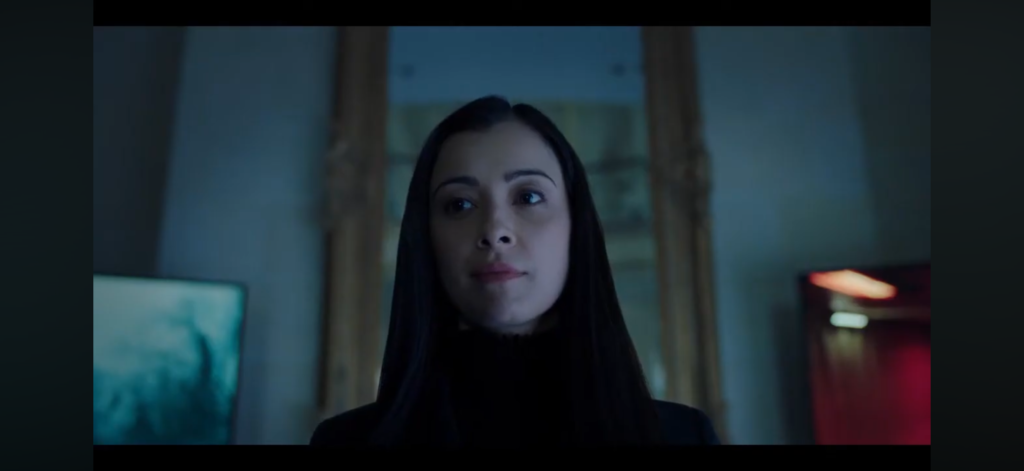
“End of the World” opens on Elaine standing at that crossroads. Piano — a career built on her father’s dream, wearing her father’s fingerprints. Or teleporter research and development — a different version of her father’s dream, still wearing his fingerprints, but at least honest about it. She chooses the research. And the episode is not interested in celebrating that choice. Because the real question — what does Elaine want, separate from what her father wants — remains unanswered. She has not broken free. She has simply moved from one room in her father’s house to another.
The monitor she installs in his room so he can watch the teleportation demonstration says everything. She arranges the screen at exactly the right angle. She makes sure he has a clear sightline. She reports back to him that Henry liked the room she built. And when Nikolai tells her this, something in Elaine visibly relaxes — a tension she has been carrying releases, just slightly, just briefly, before the next round of needing to be enough begins. The piano is gone. The need for his approval has simply found new instruments to play itself on.
The Room That Elaine Built
Let us be precise about what Elaine has created.
She built Henry a replica of her own bedroom — a reconstruction so detailed, so architecturally faithful to the original, that Henry did not immediately recognize it as a copy. Every object. Every surface. Every personal detail assembled from surveillance data, photographs, and the kind of intimate study that, in any other context, would be called obsession.
This is presented in the episode as a gesture of care. Elaine wanted Henry to feel at home. She wanted the transition into captivity to be gentle, cushioned, familiar. And this is, in its way, the most disturbing thing about Elaine — not that she is cruel, but that she genuinely cannot see the cruelty in what she has done. She built a beautiful cage and furnished it with the subject’s own memories and called it kindness.
The other teleporters did not get this consideration. Dominic was tortured and killed. His family with him. The research that Elaine is now pouring herself into produced those outcomes. The room she built for Henry is not evidence that Cleartech has changed its methods. It is evidence that Cleartech has gotten more sophisticated about concealing them. Comfort, it turns out, is an excellent anesthetic for a prisoner who doesn’t yet know they are one.
The Bombed-Out Church
Henry teleports to Bucharest.
Specifically, she teleports to the one place that tells you more about Nikolai than anything he has ever said: a bombed-out church in Romania, half-collapsed, the walls still carrying the scorch marks of the explosion that ended his family. He comes here alone. He burns candles for the dead — for his mother, for Milos, for every person the bombing consumed. And then he sits in the rubble and thinks.
This is what Nikolai looks like when no one is watching him. Not the operative. Not the enforcer. Just a man in the ruins of the worst night of his life, keeping a vigil for people who have been gone for decades. Henry finds this place because Townes told her plainly what Nikolai is: a murderer. She is not looking for absolution for him. She is looking for the complete picture — because a murderer who burns candles for the dead is not a simple thing, and Henry has learned to distrust simple things.
She goes to his favorite restaurant next. She tries his food — the meal he orders when the weight of everything becomes briefly bearable, the small ritual of an ordinary human pleasure that he allows himself between the things Cleartech sends him to do. She speaks to Daniella, his childhood friend. She is assembling Nikolai from the outside in, constructing a portrait of the person beneath the operative, asking the question that the series keeps returning to: how does someone become this?
The answer, piece by piece, is becoming clear. And it is not comforting.
Evidence That Doesn’t Count
Sheriff Anna is no longer a police officer. The badge is gone. The authority has been stripped. What has not been stripped is the impulse — the deep, stubborn, almost constitutional inability to leave something wrong alone just because the system has decided it should stay that way.
She breaks into a house. She secretly records Nikolai. She obtains evidence that, in any just accounting, would matter enormously.
It is inadmissible. Every frame of it. Every word. Gathered illegally, by a person with no authority to gather it, in a jurisdiction that has already closed its books on the case. The legal system — the same system that Anna served faithfully enough to sacrifice her career for — looks at what she found and sees only the method of its finding. The truth inside the evidence is irrelevant. The container it arrived in is contaminated. This is how the law works. It is also, the episode understands, how the law can be used: not to pursue truth, but to determine which truths are permissible.
Anna, meanwhile, is deteriorating in ways that go beyond professional loss. Her mother Eva watches her daughter and recognizes the pattern with a parent’s terrible clarity. After the controversial shooting that ended Anna’s career, she began seeing the dead boy — his face appearing in her peripheral vision, the guilt made visual and specific. Now she is seeing bodies on roads. The haunting has broadened. What began as one unbearable consequence has expanded into something more diffuse and more consuming.
The episode follows Anna to the coroner’s office, where she attempts to access medical evidence she has no legal right to view. She sees ghosts there too. And she is caught by another officer — someone who still carries the badge she no longer has, standing in the space she used to occupy, looking at her with the specific pity reserved for people who cannot let something go. Anna doesn’t look ashamed. She looks like someone who has accepted that the cost of continuing to see clearly is being seen as unstable by everyone around her.
Clay, Lucas, and the Question of Power
Clay is trying to convince Lucas that Henry has an extraordinary ability. He is right. He is also the last person whose testimony on the subject carries any moral weight, given the trajectory of what Clay represents in this series — the way victimhood can be performed, the way the injured party in one story can be a different kind of villain in another.
The episode raises a comparison that is quietly devastating: imagine the strongest fighter you know — someone who has won every physical confrontation they have ever been in, who has never had reason to question their dominance. Now put them across from someone who doesn’t want to fight, who hates fighting, who has never defined themselves by force.
And watch them lose. Badly. Publicly. The teleporter doesn’t need to overpower the fighter. They simply need to not be where the fighter’s hands are. The strongest man in the room is helpless against someone who is never in the room when the punch lands. Power, the episode is saying, is a context-dependent concept. And the contexts are shifting.
Jenna
Jenna says it plainly, without drama: she is losing herself. She doesn’t know what she wants anymore.
The episode acknowledges something about identity that most television still struggles with — that it is not a fixed destination but a process, sometimes a turbulent one. That who you are at one stage of your life may not be who you are at the next. That sexuality and selfhood can shift and evolve and contradict earlier versions without any of those versions being false. Jenna is not confused in the way that dismissive people mean when they use the word. She is in the honest, difficult middle of becoming something she doesn’t yet have a name for.
Cleo’s advice is, as always, the kind of advice that sounds simple and is almost impossible to live: follow your gut. The things people do for you, the things they acquire for you, the identities they have assigned to you — none of that is the compass. The compass is internal. And it requires a level of trust in yourself that most people, Jenna included, are still building.
The End of the World Dance
Henry persuades Jenna that they are going to the dance.
The argument is clean and entirely correct: Jenna’s ex Zack is already going, with his new company, telling his version of the story of their relationship to anyone who will listen. Why should Jenna stay home while that is happening? The world, Henry points out, is ending — the dance is literally called the End of the World — and Jenna is considering sitting it out because of a boy who does not deserve that kind of power over her Friday night.
They go.
They walk in and find Zack exactly where he was always going to be — in a cluster of people, talking about Jenna, performing the social ritual of the recently uncoupled. Henry looks at Jenna and says what needs to be said: who cares what they’re saying. The world is ending.
It is a small moment. It is also the emotional core of the episode. Because “the world is ending” means something different in a show about teleporters and shadow corporations and people being tortured in replica bedrooms. Here, at this dance, with these teenagers and this music and this small ordinary heartbreak, the apocalypse is just Zack talking to Patty by the punch bowl. The scale is laughable. The feeling is not.
Henry, who has spent the episode investigating a murderer and visiting bomb sites and piecing together the architecture of a conspiracy designed to imprison her, finds a moment to stand in a gymnasium and tell her friend that the world is ending and they might as well dance. This is either the healthiest thing Henry does all episode or the most profound act of denial. Possibly both.
Townes and Zoe, Face to Face
Townes has been preparing himself for this meeting without admitting he was preparing for it.
Zoe arrives and is not what he expected. She is disabled, with a prosthetic arm. She has communication difficulties of her own — misses social cues, processes interactions differently, occupies the same kind of adjacent frequency to the neurotypical world that Townes does. They are, in the formal social sense, deeply uncomfortable together. Face to face, without the buffer of their online dynamic, the ease evaporates.
And then Zoe does something that makes the ice crack rather than shatter. She picks up her phone, opens the Dignity 2 Original Sin app, and sends him a message. Right there, in person, sitting across from him. She finds the channel they already know how to use and uses it. She does not demand that he meet her in the mode of communication that doesn’t work for him. She comes to where he is.
He can suddenly breathe again.
Zoe tells him her prosthetic arm doesn’t bother her. What bothers her is the look — the moment when someone’s eyes land on it and they stop seeing her and start seeing only that. The reduction of a full human being to their most visible difference. Townes, who understands better than most what it feels like to be seen as only one thing, says nothing. He doesn’t need to.
What the episode is doing in this subplot, beneath all the darkness of everything else, is something almost radical in its quietness: it is showing two people who find connection not by overcoming their differences but by working within them. By honoring them. By refusing the demand to be easier than they are.
What Nikolai Did for Elaine
Nikolai takes Elaine’s father’s life.
He does not do it brutally, or at least the episode does not render it brutally. He does it with the particular cold purposefulness that has defined every action he has taken in Cleartech’s service — except that this time, the calculus is different. This time, he is not solving a problem Cleartech assigned him. He is solving the problem that Elaine has been unable to solve for herself across an entire lifetime.
Her father would never be satisfied. No demonstration would have been impressive enough. No achievement would have finally, permanently earned the approval she has spent decades chasing. This is the nature of certain kinds of parental approval — it is a moving target by design, because the moment it is achieved it loses its power over you, and some parents require that power more than they require a child who is free. Elaine would have kept building rooms, setting up monitors, arranging sightlines, reporting back on whether the subject liked the cage — and her father would have watched and measured and found the next thing wanting.
Nikolai ends the cycle. He gives Elaine something she could not give herself: the absence of the person whose approval she needed. Whether this is mercy or violence or some combination of both that the English language doesn’t have a clean word for, the episode declines to rule. Nikolai lights a candle in his broken church for everyone. He probably lights one for this too.
Angel
The episode ends with Lucas watching Henry and arriving at a conclusion the series has been building toward since Bucharest.
He thinks she is an angel.
She can move through space the way scripture says angels move — instantly, without mechanical means, present in one place and then another between one breath and the next. She appears where she is needed. She is beyond the physical constraints that bind everyone else. If you have no framework for teleportation, and you encounter it in a person, and you come from a tradition that has always held that extraordinary beings walk among us — the conclusion is not irrational. It is, in fact, the oldest available explanation for the inexplicable.
But the episode refuses to answer Lucas’s question directly. It offers it instead to the audience: is she?
And the honest answer is that the question itself is the point. Henry is a girl who lost her father and carries his Walkman and works at a surf shack and visits bomb sites in Bucharest trying to understand the man who may be hunting her. She is also someone who can move through walls, carry a truck through space, and inhabit the body of her younger self in dreams. She is mundane and she is extraordinary in the same breath, in the same body, in the same story.
Whether that makes her an angel depends entirely on what you think angels are.
What is certain is that the world the episode has built around her is ending — piece by piece, institution by institution, trusted person by trusted person — and she is still standing in the ruins of it, looking for the next candle to light.
The dance is over. The world is still here.
For now.