Beneath the polyester sheen and liberated rhetoric of the 1970s festered a quieter, more insidious reality. The decade’s id was not just in the discotheques, but in the sterile hallways of the asylum, where inconvenient women were sent to be forgotten. Robert Bloch’s 1972 anthology film, Asylum, understands this implicitly. It is not merely a collection of ghost stories; it is a searing indictment of a society that pathologized female defiance. Nowhere is this more chillingly explored than in the segment “Lucy Comes To Stay,” a tale that dissects the female psyche with the cold precision of a scalpel, revealing the monster that polite society creates.
The narrative presents a classic Gothic setup: Barbara, a woman of fortune and fragility, is sequestered in her own home under the watchful eye of a stern nurse and her brother, Michael. The surface justification is her delicate mental state, but the subtext is a transaction as old as property law. Michael does not just advise; he controls. He does not just manage; he owns. Barbara, like so many wives and sisters of the era, is a ledger entry, an obstacle to be cleared. Her home is not a sanctuary but a gilded cage, and the asylum is the ultimate threat—the final, soundproof room where a woman’s voice can be extinguished forever.
Enter Lucy. She is not a ghost, but something far more terrifying: a symptom. She is the id unleashed, the secret self forged in the crucible of oppression. Where Barbara is docile and confused, Lucy is all sharp edges and cunning. She is the part of Barbara that recognizes the conspiracy for what it is: a cold-blooded plot where a brother’s concern is a mask for greed, and a nurse’s care is a guise for complicity. Lucy’s perception is the film’s darkest truth—she sees the world not as it is presented, but as it is lived by a woman with everything to lose.
The genius of the segment lies in its refusal to provide easy answers. Is Barbara truly, dangerously ill, a justification for her confinement? Or is Lucy a necessary, if monstrous, defense mechanism against a world that seeks to erase her? The film lets both realities coexist, creating a psychological vertigo. We witness Barbara’s fractured consciousness firsthand: one moment she is the terrified victim, the next she is the cold-eyed architect of her own liberation. The line between dreams and reality doesn’t just blur; it shatters. When Lucy picks up a pair of scissors, it is Barbara’s hand that holds them, but it is Barbara’s mind that is blissfully, horrifyingly absent.
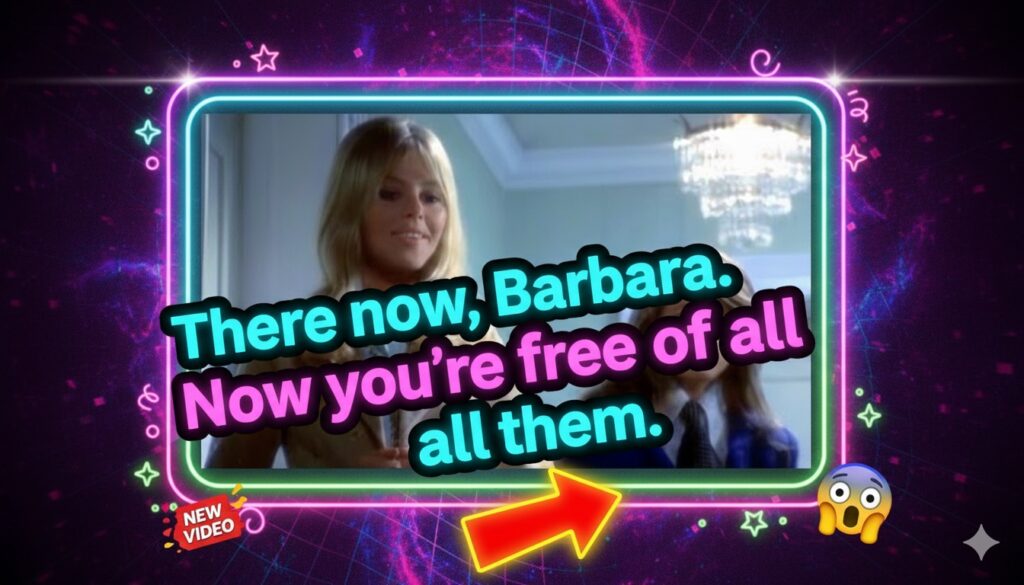
This collapse of identity reaches its bloody crescendo in the murders of Michael and the nurse. As Lucy, Barbara executes her jailers with a chilling, pragmatic fury. As Barbara, she awakens to the carnage with a genuine, gut-wrenching horror, her memory a perfect, pristine blank. This is the ultimate gaslighting, performed by one’s own mind. The patriarchy sought to control her by labeling her insane, and in the end, it is the very insanity they diagnosed that annihilates them. The system, in its ruthless efficiency, created the very monster it feared.
“Lucy Comes To Stay” endures not because of its shock value, but because of its profound bleakness. It posits that in a world that refuses to see you as fully human, the only path to agency may be through self-destruction. Barbara cannot be free as Barbara, so she becomes Lucy. But Lucy’s freedom is written in blood, leaving Barbara trapped in a new prison—one built from the ruins of her own actions, a gothic horror of the soul where the truest monster is the reflection in the glass, and the most terrifying asylum is the mind itself.