
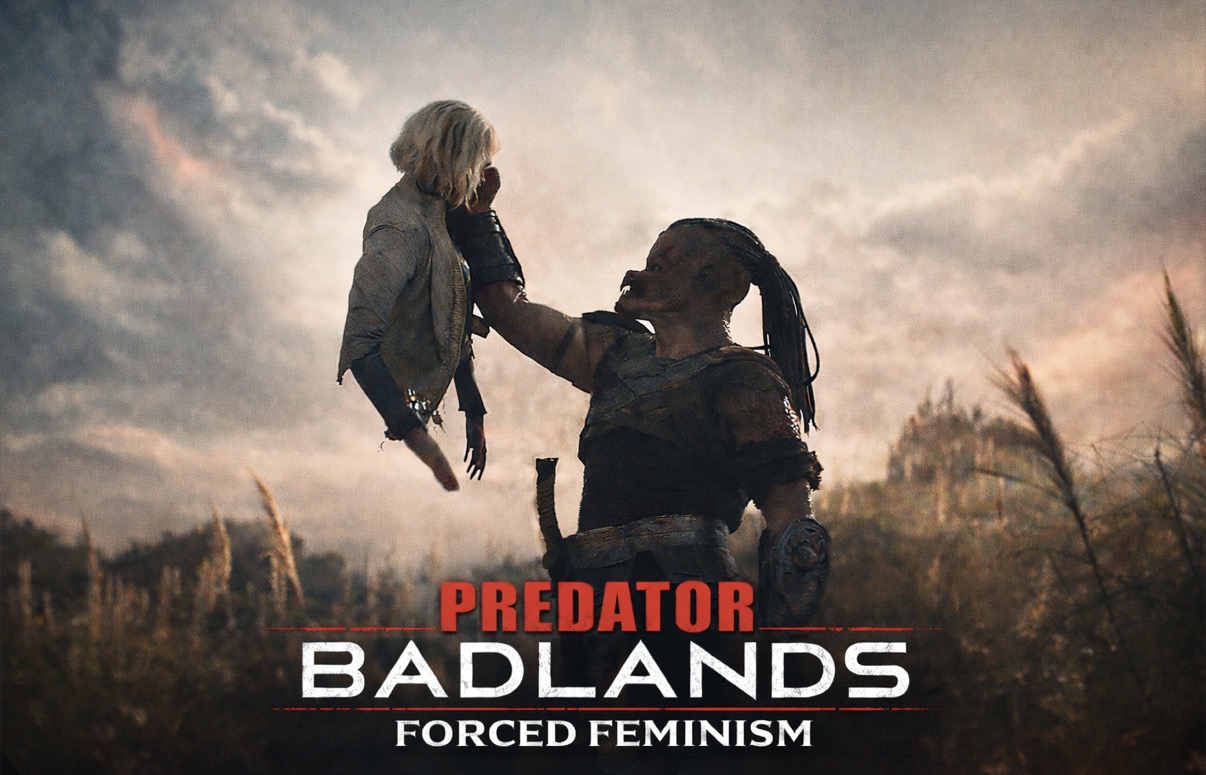
The Pitfalls of Forced Feminism in ‘Predator: Badlands’: Questioning Thia’s Role in Dek’s “Empowerment”
In Dan Trachtenberg’s 2025 sci-fi action film Predator: Badlands, the narrative centers on Dek (Dimitrius Schuster-Koloamatangi), a young Yautja exiled as a “runt” by his father, Njohrr, and thrust into survival on the deadly planet Genna. He allies with Thia (Elle Fanning), a damaged Weyland-Yutani android who guides him through perils. While some praise the film for its fresh take on the Predator franchise, a closer look reveals how its purported feminist elements—framed around Thia’s influence on Dek—fall into common traps of shallow, performative gender messaging. Rather than truly liberating men from patriarchal norms, the story often reinforces stereotypes, prioritizes female agency at male expense, and exemplifies critiques of feminism in action cinema as tokenistic or even counterproductive. This analysis critiques how feminism’s application here may not genuinely help men like Dek but instead highlights broader issues with Hollywood’s feminist portrayals.
1. Reinforcing Male Weakness Through Female Saviors
The film’s setup positions Dek as emotionally and physically vulnerable, escaping paternal execution and navigating Genna’s horrors. Thia, as his compassionate guide, teaches him vulnerability and pack-like cooperation, drawing on wolf analogies to redefine “alpha” as protective rather than dominant. On the surface, this challenges toxic masculinity, but critics argue it exemplifies “shallow feminism” in movies, where male characters are demeaned as inept or hapless to elevate women. Dek’s growth feels dependent on Thia’s interventions, portraying him as a “dumb oaf” who needs female wisdom to survive, which some see as degrading masculinity rather than empowering it. This dynamic echoes broader feminist critiques in action films, where women serve as props or sidekicks, but here it’s inverted to make men appear subordinate, potentially alienating male viewers who feel feminism undermines their roles.
2. Heavy-Handed Messaging Over Substantive Change
Badlands weaves in themes of mutual respect and shared power in Dek and Thia’s partnership, forming a “found family” with a rescued creature, Bud. Yet, this comes across as forced “feminist indoctrination,” with reviewers noting the adventure/fantasy tone sometimes veers into moralizing. Feminism’s push against patriarchal violence is evident in Dek’s shift from conquest to empathy, but such portrayals often fail to deeply engage, prioritizing spectacle over nuanced critique. Detractors argue this reflects how feminism in cinema can scare men by challenging traditional roles without offering relatable alternatives, leading to resentment rather than alliance. In action genres, where testosterone-fueled narratives dominate, inserting “girl power” elements risks commodifying feminism, making it feel like a box-office ploy rather than genuine liberation.
3. Does It Really Help Men? Broader Critiques
Proponents claim feminism frees men from emotional suppression, but in Badlands, Dek’s arc—processing trauma through Thia’s lens—may inadvertently highlight how such stories portray men as emotionally stunted until “fixed” by women. This aligns with arguments that feminism’s focus on dismantling patriarchy can make men feel threatened or morally inferior, fostering division instead of unity. Surveys show many young men view feminism as having “gone too far,” hindering their success, a sentiment amplified in media where male leads like Dek must reject their culture to thrive. While the film aims for collective growth, it risks vilifying complex masculinity, as seen in critiques of similar “empowerment” narratives that fall flat.
Ultimately, Predator: Badlands offers thrilling visuals and a unique Predator perspective, but its feminist undertones underscore persistent issues: shallow representations that may not truly benefit men and could even perpetuate gender divides. As one analysis notes, such films often prioritize performative equality over substantive critique, leaving audiences questioning if feminism here is liberating or just another hunt for relevance.