
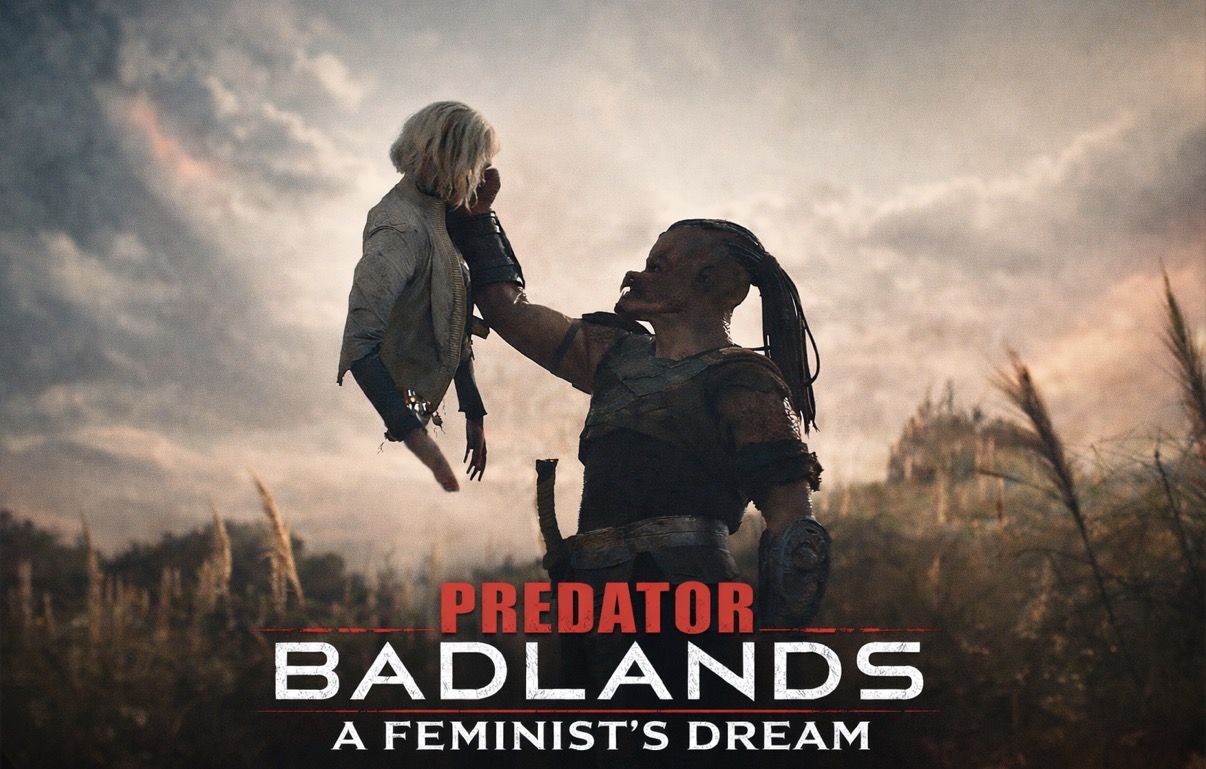
Feminism’s Liberating Force in ‘Predator: Badlands’: How Thia Empowers Dek Beyond the Hunt
In the sci-fi action thriller Predator: Badlands (2025), directed by Dan Trachtenberg, the Predator franchise takes a bold turn by centering a young Yautja named Dek (Dimitrius Schuster-Koloamatangi) as the protagonist. Exiled from his clan for being deemed a “runt” by his domineering father, Njohrr, Dek embarks on a perilous quest to prove his worth on the deadly planet Genna. There, he forms an unlikely alliance with Thia (Elle Fanning), a damaged Weyland-Yutani android who becomes his guide, confidante, and catalyst for growth. While the film delivers pulse-pounding hunts and visceral combat, it subtly weaves in feminist principles that dismantle rigid gender norms—ultimately showing how such ideals liberate men like Dek from patriarchal oppression. This application of feminism not only enriches the narrative but highlights its potential to foster emotional resilience, equitable partnerships, and societal progress for all genders.
At the heart of Badlands is a critique of toxic masculinity within Yautja society, where strength is measured by dominance and killing prowess. Dek’s father embodies this: he orders Dek’s execution for perceived weakness, reinforcing a hyper-masculine hierarchy that suppresses vulnerability. Feminism challenges these stereotypes by promoting emotional expression and diverse masculinities, and Thia— a female-coded synthetic with wit and compassion—serves as the vehicle for Dek’s transformation. When Dek insists on being “the alpha who kills the most,” Thia counters with Earth’s wolf analogy: true alphas protect and nurture their pack, not just conquer. This lesson helps Dek process his brother’s death and his father’s betrayal, allowing him to vent anger and embrace sensitivity as a strength rather than a flaw. Critics note this shift makes Dek “gentle” and “sensitive,” turning his “bullied” upbringing into an asset that aids his survival. By rejecting solitary machismo, Dek avoids the isolation that plagues men under patriarchy, mirroring real-world benefits like reduced mental health stigma.
The dynamic between Dek and Thia also exemplifies how feminism improves relationships through mutual respect and shared power. In a genre often dominated by lone warriors, their partnership thrives on equality: Thia provides strategic intel and repairs, while Dek offers physical protection, but neither is subordinate. This echoes feminist advocacy for balanced dynamics, where men are freed from being sole providers or dominators. Their bond extends to a “found family” with Bud, a creature they rescue, culminating in Dek defying his clan to declare Thia and Bud as his true kin. Some reviewers decry this as “heavy-handed feminist messaging” or “Disney indoctrination,” but it aligns with feminism’s goal of collective liberation—Dek gains deeper connections and confidence, unburdened by toxic expectations.
Broader themes address violence and health disparities tied to gender roles. Yautja culture’s emphasis on lethal hunts mirrors patriarchal pressures leading to higher male risks, like violence or early death. Feminism’s push for non-violent resolutions shines when Dek spares enemies and prioritizes rescue over conquest, potentially extending his “life expectancy” in this brutal world. Thia’s influence humanizes him, promoting consent and empathy amid chaos.
Ultimately, Predator: Badlands demonstrates feminism’s inclusivity: by allying with Thia, Dek transcends his clan’s patriarchy, emerging stronger and more fulfilled. As one analysis praises, the film offers a “wildly refreshing take on gender,” blending action with heart to show equality benefits everyone—even alien hunters. In a franchise built on predation, this evolution proves feminism isn’t anti-men—it’s anti-oppression.