
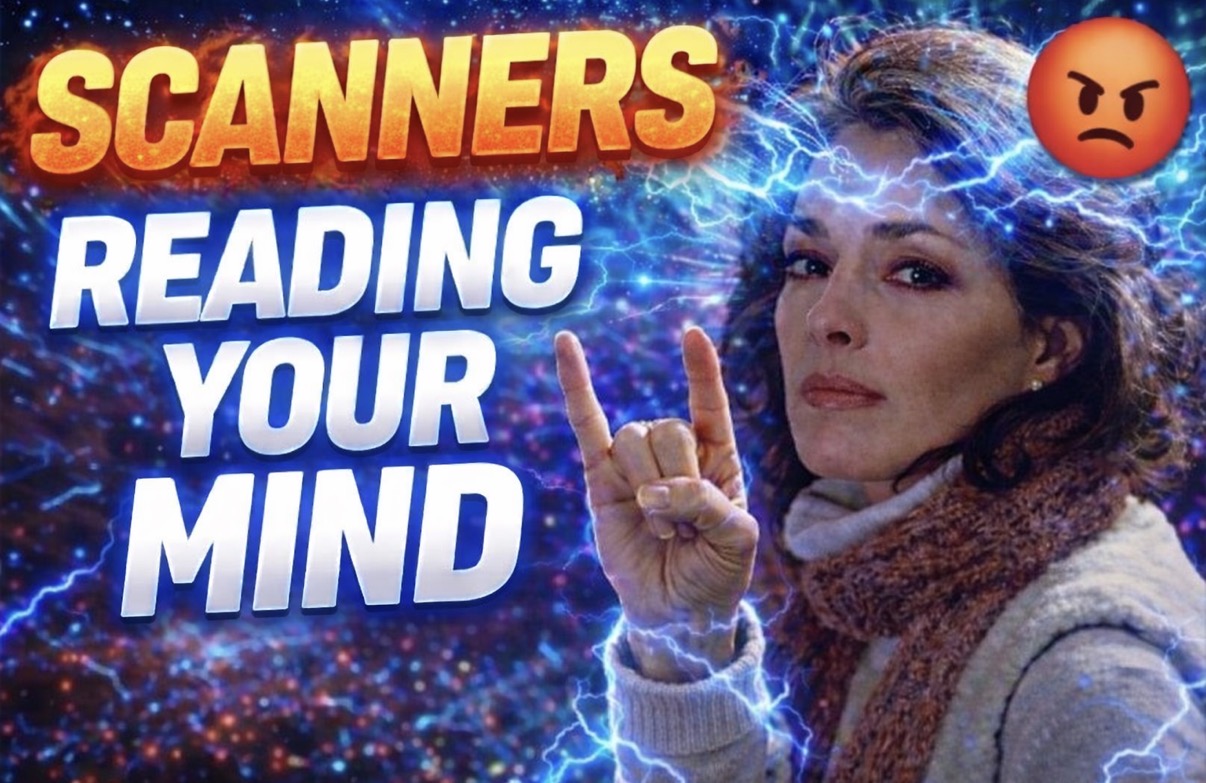
In the shadowy underbelly of 1980s cinema, David Cronenberg’s Scanners (1981) emerges not as mere science fiction horror, but as a chilling blueprint for government-orchestrated mind control in a post-modern dystopia. Often misremembered as a 1970s relic, this film explodes onto the screen with psychic mutants—known as “scanners”—whose telepathic abilities to invade minds, manipulate bodies, and even cause heads to detonate represent humanity’s next evolutionary leap. But beneath the gore and psychic duels lies a darker conspiracy: a tale of state indoctrination, corporate betrayal, and the systematic erasure of those who threaten the status quo. Drawing from the film’s raw essence, we delve into its conspiratorial depths, revealing how governments weaponize medicine, art, and ideology to crush emergent powers that could upend their iron grip on society.
At its core, Scanners exposes a clandestine government program designed to indoctrinate nascent scanners, mirroring the insidious tactics of religious cults. Imagine a world where the state plays god, rounding up these evolved beings under the guise of “protection” or “integration.” The protagonist, Cameron Vale, a homeless scanner tormented by unchecked psychic noise, is plucked from the streets and subjected to this regime. It’s no accident that this echoes church indoctrination programs—ritualistic brainwashing sessions where vulnerability is exploited to forge loyalty. But Cronenberg’s vision goes deeper: scanners aren’t just recruits; they’re lab rats in a vast experiment. Governments deploy medical knowledge with ruthless precision, measuring every neural twitch, every psychic surge. Scanners start as objects—probed, quantified, dissected like specimens under a microscope—only to become unwitting subjects, internalizing their own oppression. This Foucauldian shift from object to subject is the ultimate control mechanism in our surveillance-saturated world, where data becomes the chains that bind. Think of it as the precursor to modern psyops: Big Brother doesn’t just watch; he rewires your brain to watch yourself.
When subtle control falters, the conspiracy escalates to brute force, unveiling the state’s true face. Drugs like Ephemerol—ostensibly a suppressant for scanner abilities—are force-fed to “deafen” their powers, turning evolutionary gifts into muted curses. And if that fails? Assassination. The film doesn’t shy away from depicting how far regimes will go: scanners are hunted, executed, or worse, warehoused in criminally insane asylums. These aren’t mere prisons; they’re black sites for the psychically gifted, echo chambers of madness where the government dumps threats to its monopoly on power. It’s a stark allegory for real-world conspiracies like MKUltra, where the CIA dosed unwitting citizens with LSD to explore mind control, or the alleged suppression of whistleblowers in asylums during the Cold War. In Scanners, this police-state machinery evokes wartime Nazi experiments or, as some theorists argue, the perpetual “wartime” of modern standing armies—endless surveillance justified by phantom threats. The message is clear: evolution is a crime if it empowers the masses over the elite.
Yet, amid the darkness, scanners claw back agency through unexpected means, highlighting the film’s subversive undercurrents. Art becomes their clandestine rehabilitation tool—a way to channel chaotic powers without succumbing to the public gaze. They shun society, knowing exposure invites extermination. Enter Benjamin Pierce, a standout character whose isolationist ethos adds layers of tragic irony. This reclusive artist, holed up in his studio, scoffs at the scanner plight with a bitter laugh, pleading, “Just leave me alone.” He embodies the lone wolf scanner, using sculpture to tame his inner turmoil, but his awareness of the encroaching doom—government hit squads closing in—seals his fate. Pierce’s death isn’t random; it’s a ritual sacrifice, a warning to any scanner daring to opt out of the collective fray. His demise underscores the conspiracy’s reach: even hermits aren’t safe from the web of control.
Evolutionary undertones amplify the paranoia, positioning scanners as harbingers of a new human order. Dr. Paul Ruth, the well-meaning but naive scientist, posits that scanners could benefit humankind, their powers a boon for medicine or communication. But this optimism crumbles under scrutiny. When scanners train together, they tap into a collective mind—a shared memory bank that feels eerily communal, almost socialist or communist in its erasure of individuality. It’s as if they’re fragments of a single source, pooling thoughts like a hive mind. The film draws biblical parallels: their focused group power evokes the Tower of Babel, where unified humanity challenged the divine, only to be scattered by confused languages. Here, scanners’ terrifying synergy could topple towers of power—governments, corporations—but the elite strike first, sowing division to prevent unity. This isn’t just sci-fi; it’s a nod to conspiracy theories about suppressed technologies, like free energy or psychic research, allegedly buried by oil barons and intelligence agencies to maintain scarcity and control.
The real war in Scanners is ideological, a shadowy battleground where factions vie for psychic supremacy. Darryl Revok, the scarred antagonist, leads a rogue private network of scanners, championing individualism over collective harmony. His underground rivals push a socialist model, merging minds for greater strength. Meanwhile, the government plays both sides, indoctrinating neutrals like Cameron Vale while plotting to eliminate Revok’s privatized threat. Vale, initially apathetic to humanity, becomes the prize in this tug-of-war, his “rehabilitation” a euphemism for brainwashing. But the conspiracy’s masterstroke is the betrayal at ConSec, the biochemical firm birthed from Dr. Ruth’s sold-out company. Ruth, duped into creating Ephemerol, unwittingly serves Revok, who secretly pulls the strings. The government hunts Revok, yet funds the very entity he controls—a hall of mirrors where allies are enemies. Traitors abound, evoking feminist theorist Judith Butler’s critiques of neoliberalism: those who nonconform, like internal saboteurs at ConSec, disrupt the “movement” from within, blurring lines between resistance and co-optation. It’s a prescient warning about corporate-government fusion, akin to Big Pharma conspiracies where vaccines or drugs allegedly suppress human potential for profit.
In the end, Scanners isn’t just a film; it’s a manifesto shrouded in body horror, urging us to question the invisible scanners in our own world—algorithms reading our thoughts, governments dosing populations with compliance. Cronenberg peels back the veil on how evolution is commodified, collectivized, or crushed to preserve the old order. As scanners’ heads explode in visceral metaphor, so too does the illusion of freedom. Watch it, but beware: in this conspiracy-laden reality, the next scan might be your own.